
The Perpetuum Mobile, a machine which can just be made out in the shadowy right background of the Linder Gallery (no. 43 in the zoomable image), is not the only invention of Cornelis Drebbel (1572-1633), nor perhaps even the most significant, but it is certainly the one for which he was best known by his contemporaries, and the one of which he remained most proud. It is also the instrument about which most has been written – both by his contemporaries and by modern scholars. First demonstrated in late 1604, the fame of Drebbel and his Perpetuum Mobile spread rapidly, and the Perpetuum Mobile was still being cited as late as the 19th century, long after Drebbel himself had passed into obscurity.
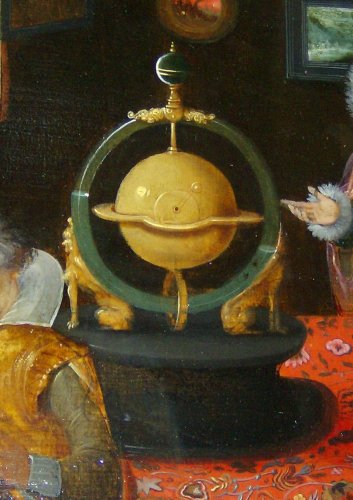
Cornelis Drebbel's Perpetuum Mobile, detail from Hieronymus Francken the Younger, The Archdukes Albert and Isabella Visiting a Collector's Cabinet, The Walters Art Museum, Baltimore. Compare the shadowy device at no. 43 in the zoomable image of the Linder Gallery
By all accounts, Drebbel’s instrument combined two features, first, a self-winding astronomical almanac showing the date and the phases of the moon, and second, a cylindrical ring in which water moved endlessly to and fro. Even if the Perpetuum Mobile was only a simple air thermoscope (relying on temperature changes), or at best a crude baroscope (subject to changes in air pressure), Drebbel invested it with great mystery and great value, and saw it as a confirmation of the principles he elaborated in his Ein Kurßer Tractat von der Natur Der Elementen first published in 1608. Although clearly his claim was unfounded, perhaps we at least to try to understand what he thought he was doing when he speaks of the instrument’s secret as ‘the fiery spirit of the air’. Perhaps the glass cylinder was filled not with mere air, but with oxygen produced by heating saltpetre, or nitre, which Drebbel was convinced held the secret to chemical transformations of many kinds. As Jennifer Drake-Brockman astutely observes, Drebbel stands on the threshold between two ways of looking at the natural world. As she writes ‘On the one hand, were those philosophers, including Drebbel himself, who explained the machine in mystical or alchemical terms, and whose mind-set might be described as the Rosicrucian tendency; their thinking was ultimately grounded in the Aristotelian universe, the building blocks of which were the four elements. On the other hand, were the exponents of the scientific tendency, whose efforts were directed towards an understanding of observed physical phenomena and to whom the Aristotelian worldview was increasingly an irrelevance; […]’. Drebbel’s alchemy was indeed Aristotelian, and he accorded nitre a special significance as part of Paracelsus’s tria prima of Mercury, Sulfur and Salt, hence his experiments with cooling, underwater travel, explosives and of course, the Perpetuum Mobile.
Comments 6
About Drebbel, take a look at http://www.drebbel.net and read the dissertation of Dr. Vera Keller: Cornelis Drebbel; Fame and the making of modernity (Princeton, 2009)
On http://www.drebbel.net/1621%20PtPM.pdf you’ll find an article written by Heinrich Hiesserle von Chodaw in 1621 containing a functional description and a drawing of the instrument shown in this painting.
Since I took the photo used in your blog post, I thought it might be OK to post a link to a page I had made (link above), where it came from, which looks into the workings of these devices. Your readers might be interested in some of the ideas I have explored, and the comparisons to the other known illustrations of Drebbel’s perpetuums. The emergence of the Lidner example is of course the first new one in some time… and also, very rare. Until it was posted online, I had held hope that it would advance our understanding of these… unfortunately, as you say, it is shadowy, and so will not reveal anything. While I am posting (I have not yet read Gorman’s book), has this painting yet been thought a Stalbemt, like the Prado and Walter’s collectors galleries? If not, why not? Great site, BTW… Rich.
As Rich says, the depiction of the perpetuum mobile is too shadowy to reveal anything about the structure of the device, but the very fact that it has been dumped in a dark corner, where there is no possibility of its functioning, may be its real significance in the picture. Its usual place in galley interior paintings, on the sunny table under the window, has been taken over by a very fine example of an armillary sphere, i.e. a serious scientific instrument of the time. Could this not be a deliberate denigration of the magical / Paracelsian / Rosicrucian interpretations of the cosmos that some of its admirers attached to the perpetuum mobile? Furthermore, Thomas Tymme in his Dialogue Philosophicall claimed the perpetuum mobile as ‘evidence’ for the geocentric world system, so the device’s ignominious situation may in itself be a contribution to the debate going on elsewhere in the picture. In this connection, may I make a suggestion about the shadowy object next to the perpetuum mobile, which looks like a rear side view of the muscular torso of a statue in a kneeling posture? One of the best-known statues in the Farnese collection is the second-century AD kneeling statue of Atlas supporting a celestial globe on his shoulders, illustrating the classical myth of the giant who held up the heavens. This statue could well have been known to the painter(s) involved in this picture. The juxtaposition of Atlas and perpetuum mobile in the gloomy corner would be a further derogatory comment on the worth of the latter; the myth of Atlas and the weird and wonderful theories associated with the machine are on a par and to be dismissed to obscurity. The third object in the corner, comparatively well-lit, is a small, dignified statue of a bearded man in the guise of a classical Greek philosopher or writer. Given that Drebbel’s perpetuum mobile was so often linked in poetry and prose with the marvellous globe invented in antiquity by the Syracusan natural philosopher and mathematician Archimedes, it would make sense that this figure is intended to represent him.
Pingback: MILLENNIUM ATMOS CLOCK « Shakespaedia
Awesome that Drebbel’s perpettum mobile appears in the Linder Gallery! As it turns out, it is difficult to find thorough documentation on the life and works of Cornelis Drebbel. Any advice?
In 2015, Jennifer Speake published a paper on Drebbel vis-a-vis Ben Jonson in the Review of English Studies (https://doi.org/10.1093/res/hgu059). In a footnote, she announced: “There is no adequate biography of Drebbel currently available in English, a lacuna that I am proposing to remedy with my forthcoming book The Magus and the Maker”. I cannot find any trace of this book. Does anyone have a clue? Much appreciated.